Technology explained
Electric Brakes Are Ready for the Road Ahead
How brake-by-wire works, how engineers keep it safe, and why it fits the next generation of passenger vehicles.
Press a brake pedal in almost any car built during the last hundred years and the basic idea is the same. Your foot builds pressure in brake fluid. That pressure travels through metal lines and hoses. Pistons at the wheels squeeze pads against spinning discs. It is a simple idea refined through decades of hard use.
The next generation changes the path between your foot and the wheels. Sensors read the pedal. Computers decide how much braking each wheel needs. Electric power creates the force. In a fully dry system, small electric motors at the wheels clamp the pads against the discs. The fluid lines disappear.
That sounds like a big leap when braking is the one system nobody wants to question. The real story is much less dramatic. Cars have been handing part of the braking job to electronics for decades. Anti-lock brakes, stability control, automatic emergency braking, electric parking brakes, and regenerative braking already depend on sensors, software, and powered actuators. Dry electromechanical brakes bring those pieces together and remove the hydraulic service system.
First, "electric brakes" can mean several things
The language gets confusing because several systems share the brake-by-wire name. A modern hydraulic brake-by-wire system reads the pedal electronically. It then uses an electric pump or actuator to build hydraulic pressure. Brake fluid still carries force to the wheels. Systems such as Continental's MK C1 have used this approach in production vehicles since 2016.[9]
A semi-dry system mixes the two designs. One axle may use electric wheel actuators while the other keeps hydraulic calipers. ZF announced a major order in 2025 for a layout with electromechanical rear brakes and hydraulic front brakes. The agreement covers nearly five million vehicles.[11] This approach lets manufacturers introduce the technology in stages.
A fully dry electromechanical brake, often shortened to EMB, replaces the service-brake fluid circuit. Each wheel gets an electric actuator. A motor turns a reduction gear or ball-screw mechanism. That motion creates a strong clamping force. The disc and pads still create friction at the wheel. The method used to squeeze them changes.
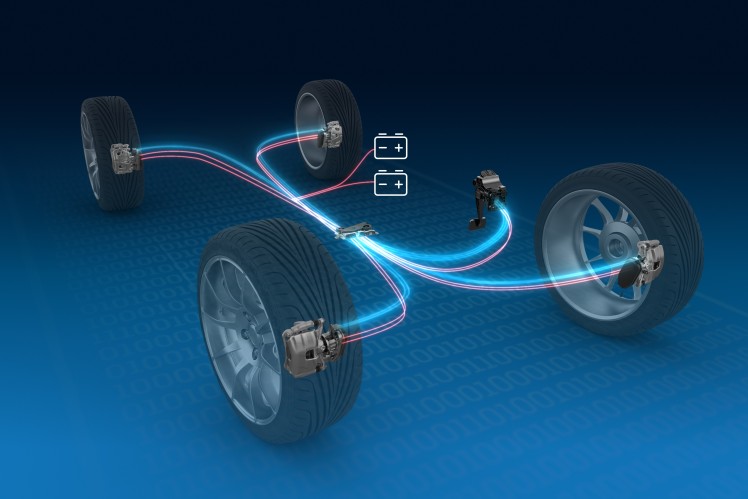
How the system works
The driver pushes the pedal. Two or more sensors measure the request. A pedal simulator supplies the resistance and travel that the driver feels. The brake controller also reads wheel speed, steering angle, vehicle motion, road grip, and battery condition. It can also receive a request from automatic safety systems.
The controller divides the work among regenerative braking and the friction brakes. During light slowing in an electric vehicle, the drive motor can act as a generator. It sends energy back to the battery. The wheel brakes add force when the battery is full, cold, hot, or unable to accept enough power. They also take over at low speed and during a hard stop. The handoff has to feel natural through the pedal.
At each wheel, a position or force sensor confirms that the actuator followed the command. The computer can release pad pressure after the stop. This keeps the pads from lightly rubbing the discs. It can also watch pad travel over time and estimate wear. That gives the vehicle a much clearer picture of brake condition than a simple warning tab on a pad.
Safety starts with expecting parts to fail
A safe brake-by-wire design assumes that sensors, wires, processors, and power supplies can fail. Engineers then build independent paths around those failures. The exact layout changes from one vehicle to another. A supplier drawing can't prove the safety of every future car.
Pedal sensing
Separate sensors compare readings. A disagreement creates a fault before one bad value can quietly control the brakes.
Electrical power
Independent feeds, backup energy, or a second electrical system can preserve braking after a power fault.
Computing and communication
Separate processing and signal paths check one another. Errors trigger a warning and a planned degraded mode.
Wheel actuation
Each actuator reports its position and force. A fault at one corner can be isolated while the remaining system supplies controlled braking.
The phrase "fail-operational" needs context. It means the system keeps providing a defined level of operation after certain faults. It doesn't promise full performance after every possible failure. A good design states which faults it covers. It also states how much braking remains, how the driver is warned, and how the vehicle behaves while stopping.
ISO 26262 gives automakers a process for finding hazards and setting safety goals. ASIL D is the highest risk level in that process.[1] It applies to a safety goal after a hazard analysis. The complete vehicle still has to prove its braking performance. In the United States, FMVSS 135 covers stopping distance and system warnings. It also covers performance during specified failures.[2] UNECE rules include requirements for brakes powered by stored electrical energy.[3]
Cybersecurity belongs in the same discussion. A connected brake controller needs protected communication and controlled software updates. Its design must keep outside data away from the final safety decision. ISO/SAE 21434 covers cybersecurity engineering across the vehicle life cycle.[15]
All of that ends at the tire. Faster electronics can build force sooner and divide it more accurately. This helps most on a road with mixed grip. Tire condition and road friction still set the hard limit on stopping distance. ZF has published a test-based claim of up to nine meters shorter during one automatic-emergency-braking comparison at 100 km/h.[10] That result uses ZF's stated test and comparison. It isn't a promise for every vehicle or road.
This technology already has a history
Passenger cars have used electronic brake control long enough to give us both success and useful failure history.
- 1997 to 2001: Toyota used regenerative braking in the first Prius, then introduced its Electronically Controlled Brake system on the 2001 Estima Hybrid. The controller blended regeneration with hydraulic friction braking.[4]
- Early 2000s: Mercedes-Benz put Sensotronic Brake Control into production. A 2004 recall covered a weakness in the system's monitoring function. The hydraulic backup required more pedal force and longer stopping distance in that condition.[5] The lesson was direct: degraded behavior and clear warnings matter as much as normal operation.
- 2011: The Boeing 787 entered airline service with electric wheel brakes from Safran. It became the first commercial aircraft with that technology. By April 2025, the 787 fleet had completed nearly five million flights.[7][8] Aircraft hardware differs from a passenger-car brake, though the service record proves electric actuation can handle a safety-critical job.
- 2014: Formula 1 began using brake-by-wire control at the rear axle to manage the changing mix of regenerative and friction braking. FIA rules included a hydraulic fallback.[6]
- 2016: Continental's integrated MK C1 electrohydraulic brake entered production. It combines brake actuation, stability control, and boost functions in one unit.[9]
- 2025 to 2026: ZF announced its large semi-dry production order. Bosch said its hydraulic brake-by-wire system was expected to begin passenger-car volume production in mid-2026.[11][12] In May 2026, Brembo announced that its fluid-free SENSIFY system had entered production for an unnamed global vehicle manufacturer.[13]

Where electric braking improves the passenger vehicle
Hydraulic strength
Hydraulic brakes have decades of production history, common service tools, familiar failure behavior, and low manufacturing cost. Split circuits can preserve partial braking after a leak.
Electric opportunity
Electric brakes give the controller direct command of each wheel, remove fluid service, improve packaging, and fit naturally with regeneration and automated driving.
Faster and more exact wheel control
A central hydraulic system builds pressure and sends it through lines. An electromechanical system can command each wheel directly. That opens the door to quicker pressure buildup, tighter stability control, and better use of grip when the left and right sides of the car are on different surfaces. The final result depends on the full vehicle calibration.
Cleaner regenerative-brake blending
Regeneration changes constantly with speed, motor capacity, battery temperature, and state of charge. Electronic control can blend that changing force with the friction brakes while keeping the driver's pedal response steady. Better blending can recover more energy. The amount varies by vehicle and drive cycle. The U.S. Department of Energy explains that regenerative braking captures energy that friction brakes would turn into heat.[14]
Less drag and brake dust
A wheel actuator knows where the pad sits and can pull it back slightly after braking. Reducing unwanted pad contact lowers drag, heat, and wear. Regenerative braking also reduces the number of friction-brake events. Those changes can cut brake dust and save energy. Supplier range claims depend heavily on the comparison vehicle, test cycle, and battery limits.
Less scheduled service
A dry system has no service-brake fluid to absorb moisture, flush, bleed, or leak. Pads and discs remain wear items. Motors, gears, seals, wiring, and sensors bring their own inspection needs. Service becomes more diagnostic and less fluid-based.
Better packaging and assembly
Removing a master cylinder, booster, reservoir, long fluid lines, and factory bleeding steps can simplify vehicle assembly. Engineers gain more freedom around the firewall and front storage area. Electric actuators add weight at the wheels, so the complete design still has to earn its place.
A better match for driver-assistance systems
Automatic emergency braking, adaptive cruise control, stability control, parking assistance, and future automated driving all need predictable speed control. A brake system built around electronic commands fits that job well. Software can coordinate braking with steering, suspension, and the powertrain. The systems can work from the same plan.
The concerns deserve straight answers
Early systems will cost more. Repair training will take time. Wheel actuators live beside heat, water, salt, ice, vibration, and impact. Their seals, wiring, motors, and gears need years of validation. A 12-volt battery alone may be a weak base for four powerful actuators. Many designs use backup energy, higher voltage, or a second power path.
Pedal feel also becomes a design choice. That can produce a smooth and consistent pedal across regenerative and friction braking. Poor calibration can feel artificial. Drivers should judge the finished car, especially during low-speed stops, rough-road braking, and the point where regeneration hands the work to the pads.
Software updates create another responsibility. Brake software needs controlled releases, traceable changes, cybersecurity review, and a way to recover from an interrupted update. Owners deserve clear service information and fault warnings that say what the vehicle can still do.
For me, the proof comes from the complete vehicle. I want to know how it stops with a failed sensor, a damaged wire, low system voltage, one disabled wheel actuator, and a communication fault. I want cold-weather, hot-weather, corrosion, water, vibration, and long-term wear results. I also want a clear answer about backup power and parts availability.
- Does the vehicle meet the same stopping rules used for other passenger cars?
- Which failures allow normal braking, and which failures trigger degraded braking?
- How much stopping power remains in each degraded mode?
- How is backup electrical energy stored and checked?
- Can one wheel actuator fault stay isolated from the other three?
- What maintenance schedule applies to actuators, pads, discs, and backup power?
- How will software updates and cybersecurity fixes reach the vehicle?
What happens next
The rollout will likely happen in steps. Electrohydraulic brake-by-wire is already common. Semi-dry systems give manufacturers a practical bridge. Full dry systems will begin with programs where efficiency, packaging, software control, and automated-driving support justify the cost.
Scale will lower actuator and electronics costs. More 48-volt systems will make power delivery easier. Service procedures will mature. Regulations will keep adding clear rules for stored electrical energy, warnings, degraded operation, and automated braking. The best systems will disappear into the driving experience. The pedal will feel natural, the car will stop cleanly, and most owners will think about the hardware only when the service screen reports pad wear.
My bottom line
Electric braking deserves careful questions because brakes carry real consequences. It also deserves an honest look at the record. Electronic brake control has worked in passenger cars for decades. Electric wheel brakes have worked in commercial aviation since the Boeing 787 entered service. Formula 1 has spent more than a decade blending regeneration and rear friction braking by wire. Production passenger vehicles are now taking the next step.
The future depends on redundant power, independent signal paths, strong fault detection, honest degraded modes, secure software, and public test results. When a manufacturer proves those points in the complete vehicle, a fluid-free brake system can be safer to control, easier to service, more efficient, and better suited to the modern car.
Sources
- ISO: Road vehicles functional safety and the ISO 26262 framework
- NHTSA: FMVSS 135 Light Vehicle Brake Systems test procedure
- UNECE: 2024 braking provisions for systems using stored electrical energy
- Toyota: Chassis technology history, regenerative braking, and Electronically Controlled Brake
- NHTSA: 2004 Mercedes-Benz Sensotronic Brake Control recall report
- FIA: 2014 Formula 1 technical briefing on rear brake-by-wire and hydraulic backup
- Safran: Boeing 787 Dreamliner electric brake
- Boeing: 787 fleet passes one billion passengers and approaches five million flights
- Continental: MK C1 integrated brake system production history
- ZF: Dry brake-by-wire system and supplier performance claims
- ZF: 2025 order for a hybrid brake-by-wire system covering nearly five million vehicles
- Bosch: Hydraulic brake-by-wire orders and announced mid-2026 production timing
- Brembo: SENSIFY fluid-free braking enters production, May 2026
- U.S. Department of Energy: Electric-vehicle efficiency and regenerative braking
- ISO/SAE 21434: Road vehicle cybersecurity engineering
Supplier performance figures describe each supplier's own system, baseline, and test conditions. They should be checked against the final vehicle's independent test results.
Comments
Post a Comment